Thursday, 11 July 2013

A transgene

A transgene:
 An exogenous gene introduced into a living organism so that the organism will exhibit a new property and transmit that property to its offspring.

Transgenic animals :
The animal that carries a deliberate modification/insert into its genome, the genetic makeup of an organism responsible for inherited characteristics.

 History of transgenic animal production
  • 1966:Zygote microinjection technology established.
  • 1970's: first transgenic mice via viral infection.
  • 1977: mRNA and DNA transferred into Xenopus eggs.
  • 1980's: first transgenic mice via microinjection (the most popular technique).
  • 1985: first transgenic rabbits, sheep, pigs and cattle.
  • 1990’s:transgenic farm animals used as bioreactors and organ donors.
  • 1997: nuclear transfer using ES cells to drive transgenic sheep.
 The majority and successful transgenic animals produced so far are mice, A few years later, it was followed by rabbits, pigs, sheep, and cattle  fish, monkey, cat and cow.

Using recombinant DNA methodology

An animal contains a foreign gene (genes) introduced purposely by human intervention.

http://www.accessexcellence.org/RC/VL/GG/images/transgenic.gif
An example:
Normal mice cannot be  infected with polio virus.
Mice lack the cell-surface molecule that found in humans,  that serves as the receptor for the virus.
So normal mice cannot serve as an inexpensive, easily-manipulated model for studying the disease. However, transgenic mice expressing the human gene for the polio virus receptor
• can be infected by polio virus
• develop paralysis and other pathological changes characteristic of the disease in
humans.

 Why Transgenic Animals?
  •  Interest in transgenic animals originally fell into two broad areas:
  • Molecular farming: using livestock to produce medicines, proteins and tissues for transplant to humans.
  • Production efficiency of farm animals: Interest among researchers. 

 To date, there are three basic methods of
producing transgenic animals:


 1-Embryonic stem cell-mediated gene transfer .
2- DNA microinjection.
3 -Retrovirus-mediated gene transfer.

 The benefits of these animals to human
welfare can be grouped into areas:
  • Agriculture
  • Medicine
  • Industry

Read More

Sunday, 7 July 2013

DNA sequencing

DNA sequencing is the process of determining the accurate order of nucleotides in a DNA molecule.

DNA Sequencing requires various techniques and methods that are used to define the sequence of the nucleotide bases in a DNA molecule.

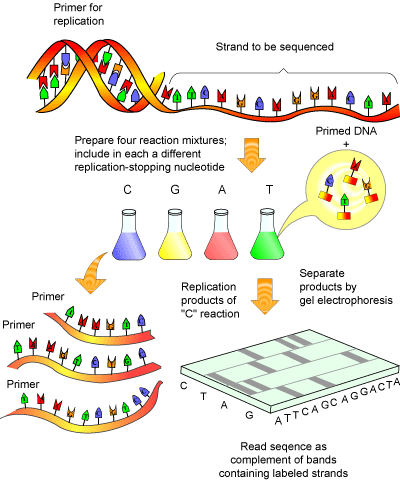
 The most common method for performance this is called the dideoxy method or Sanger method.

this method is named Sanger method after its inventor, Frederick Sanger, who was awarded Nobel prize in chemistry for this achievement in1980. 

 The Need for DNA Sequencing

1- DNA sequencing may be used to determine the sequence of individual genes, larger genetic regions (i.e. clusters of genes or operons), whole genomes.
2- Sequencing may provide, Depending on the methods used, the order of nucleotides in DNA or RNA isolated from living organisms cells such as animals, plants, bacteria, archaea, or virtually any other source of genetic information. 
3- Researchers may use the product sequences in molecular biology or genetics to further scientific progress or may be used by medical staff to make treatment decisions or aid in genetic counseling.
 

https://blogger.googleusercontent.com/img/b/R29vZ2xl/AVvXsEhwNmeaNsrAT_QTil0cmKq7Tr-I-YeZjYaFQhiL5cUPbsNmWQUMo1RGmlZzrL2JnVXceKYGRBx92pJhnatETdlvt6dZRFD62bHYc_wCZF9tK0Et1XSuAb5wk4-KUW_mczHAWndmDLvtc6M/s1600/1.gif

 The Procedure

  • At the beginning, The DNA should be prepared as a single strand to be sequenced.


  • The DNA template is supplied with :


 1-a mixture of the four normal (deoxy) nucleotides in abundant quantities

                                           A G C T

 2-a mixture of all four dideoxynucleotides, each present in limiting quantities and each labeled with a "tag" that fluoresces a different color:


                                                A G C T

 3-DNA polymerase I

Because the four normal nucleotides are present, chain elongation proceeds normally until, by chance, DNA polymerase inserts a dideoxy nucleotide that shown as colored letters instead of the normal deoxynucleotide. If the ratio of normal nucleotide to the dideoxy versions is high enough, some DNA strands will succeed in adding several hundred nucleotides before insertion of the dideoxy version halts the process.

At the end of the incubation period, the fragments are separated by length (from longest to shortest). The resolution is so good that a difference of one nucleotide is enough to separate that strand from the next shorter and next longer strand. Each of the four dideoxynucleotides fluoresces a different color when illuminated by a laser beam and an automatic scanner provides a printout of the sequence.


Read More

Saturday, 6 July 2013

intelligent genes


http://images.sciencedaily.com/2012/10/121002150027-large.jpg
Heritability of IQ
Intelligence is of primary interest to human genetic research. The first methodical set of experimental observations can be traced back to Galton’s work in 1865, a year before Mendel’s influential article on the laws of heredity. Galton estimated the transmission of several traits in families using statistical tools. He concluded that many traits including mental ability are genetically transmitted and normally distributed in the general population. He did not analyze the role of the common environment within the families, biasing his conclusions towards the genetic. He did, however, realize significant general principles such as regression to the mean in children of parents with extreme phenotypic traits.
It's all in the genes: A new study shows that up to 40 per cent of a child's intelligence is passed down from the parents.

Big Brain and Intelligence Linked to particular Genes

Brain size and smarts are, to a certain degree, genetic.

scientists have indicated that bigger brain is "smarter,". this study is considered the strongest state  for a genetic connection to brain size and to IQ. but brain size is not 100 % related to a person's intelligence, and other factors, including connections between brain cells and even a person's experiences, play roles.


 "We found fairly unequivocal proof supporting a genetic link to brain function and intelligence. For the first time, we have watertight evidence of how these genes affect the brain," said lead researcher Paul Thompson, a neurologist at the University of California.

 Another prominent genetic sequence, located within the HMGA2 gene on chromosome 12, was linked with intracranial volume. in other words, the space inside your skull that marks the outer limit as to how big your brain can get. At this spot, every C-allele variant was linked to not only lower intracranial volume, but also to lower IQ scores on the Multidimensional Aptitude Battery, a measure of intelligence.

"This is a really exciting discovery: that a single letter change leads to a bigger brain," said Thompson.


Read More

Sunday, 30 June 2013

RNA Structure

http://upload.wikimedia.org/wikipedia/commons/8/81/Rna_syn.png

-RNA (Ribonucleic acid) is a biopolymer macromolecule along with DNA.

-RNA is structurally similar to DNA!

-Both nucleic acids are sugar-phosphate polymers and both have nitrogen bases attached to the sugars of the backbone- but RNA is usually single-stranded.

there are differnces between DNA & RNA, they are :
 1- The sugar in RNA is ribose,While DNA contains deoxyribose.
 2- Unlike double-stranded DNA, RNA is usually single-stranded. However, RNA can form intrastrand double helixes, as in tRNA.
 3- DNA nucleotides include Adenine, Guanine, Thymine or Cytosine whereas RNA nucleotides uracil is present instead of thymine.
 4-  RNA molecules are shorter than DNA molecules.


 Types of RNA

- Ribosomal RNAs (rRNAs)
they are called ribosomes, exist outside the nucleus in the cytoplasm of a cell. The ribosome structure is composed of 2 subunits. A small and a large subunit.
Each ribosome is a complex consisting of about 60% ribosomal RNA (rRNA) and 40% protein.


- Messenger RNAs (mRNAs)
 firstly, DNA is transcribed into mRNA and subsequently translated into a protein product.
 these mRNAs record information from DNA in the cell nucleus and carry it to the ribosomes which found in  cytoplasm.

- Transfer RNAs (tRNAs)
Transfer RNAs are encoded by genes that also encode for the 5S size rRNA.
their function is to deliver amino acids one by one to protein chains growing at ribosomes.

- Small interfering RNAs (siRNAs)
  they are Known as short interfering RNAs, a class of double stranded RNA molecules involved in the RNA interference (RNAi) pathway. they interfere with the expression of specific genes controlling the stability of the mRNA. In this way the mRNA is disintegrated (when necessary) to avoid its overexpression with a consequent overproduction of proteins.

- Small nuclear RNAs (snRNAs)
They are transcribed by two ways, either RNA polymerase II along with mRNA or by RNA polymerase III along with all nuclear tRNAs and the 5S rRNA.
 They are primarily involved in mRNA processing such as splicing by removal of introns from pre−mRNA and also in maintenance of the telomeres. 

- Heterogeneous nuclear RNAs (hnRNAs)
hnRNA is an immature single strand of mRNA. 


Read More

Saturday, 29 June 2013

Genomic libraries

-Cloning DNA,population of recombinant DNA molecules, often in plasmid or phage vectors, maintained
either in bacterial cells or as phage particles.

- termed a clone bank or library.

-The term genomic library is often used to describe a set of clones representing the entire genome of an organism, and the production of such a library is usually the first step in isolating a DNA sequence from an
organism’s genome.

 the steps for creating a genomic library from a large genome :
  1. Extract and purify DNA.
  2. Break the DNA with a restriction enzyme, This creates fragments that are similar in size, each containing one or more genes.
  3. Insert the fragments of DNA into vectors that were cut with the same restriction enzyme. Use the enzyme DNA ligase to seal the DNA fragments into the vector. This creates a large pool of recombinant molecules.
  4. These recombinant molecules are taken up by a host bacteria by transformation, creating a DNA library

 Genomic Library Construction


Characteristics of a good genomic library In theory,


1- should represent the entire genome of an organism as a set of overlapping cloned fragments, which will therefore


 2-enable the isolation of any sequence in the genome.


3-The fragments for cloning should ideally be generated by a sequence-independent procedure, ensuring that the fragments are generated at random


4-cloned fragments should be maintained in a stable form with no misrepresentation of sequences due to recombination or differential replication of the cloned DNAs during propagation of the recombinants.
Read More

DNA Transcription & Translation


http://upload.wikimedia.org/wikipedia/commons/thumb/b/b1/Ribosome_mRNA_translation_en.svg/300px-Ribosome_mRNA_translation_en.svg.png
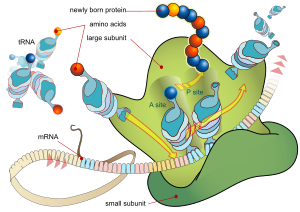
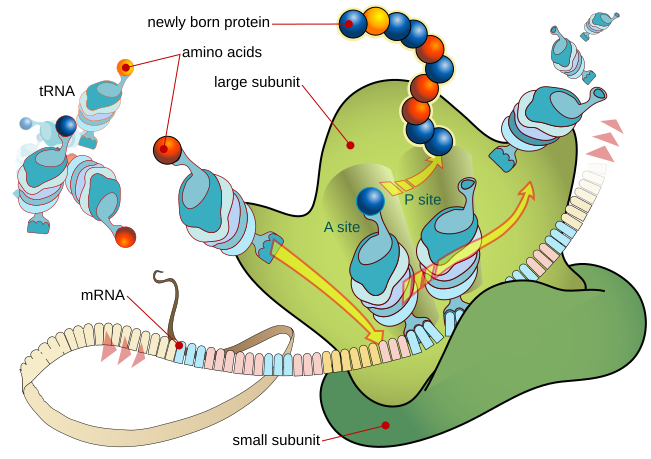
DNA translation : is the process which can be seen as the decoding of instructions for making proteins, it is part of the process of gene expression.

The process by which DNA is copied to RNA is called transcription, and that by which RNA is used to produce proteins is called translation.


http://www.atdbio.com/img/articles/central-dogma-large.png


Translation usually happens in the cytoplasm where the ribosomes are located.


Translation proceeds in three phases: initiation, elongation and termination.


Initiation:
1- factors IF–1 and IF–3, bind to the 30 S subunit
2-  Another factor, IF–2, binds as a complex with GTP
3- This allows the subunit to associate with the mRNA and makes it possible for a special tRNA to bind to the start codon  ………………………… (IF released)
 4- In prokaryotes, this starter tRNA carries the substituted amino acid Nformylmethionine
(fMet). In eukaryotes, it carries an unsubstituted methionine.
http://www.nobelprize.org/educational/medicine/dna/a/translation/pics/initiation_new.gifFinally, the 50 S subunit binds to the above complex .. ………………………… (IF released)

·         In the 70S initiation complex, formylmethionine tRNA is initially located at a binding site known as the peptidyl site (P).
·         Acceptor site (A), is not yet occupied during this phase of translation.
·         Sometimes, a third tRNA binding site is defined as an exit site (E).

The anticodon of another tRNA binds to the next mRNA codon, bringing the 2nd amino acid to be placed in the protein.

As each anticodon & codon bind together a peptide bond forms between the two amino acids.
  
After translation has been initiated , the peptide chain is extended by the addition of further amino acid residues (elongation) until the ribosome reaches a stop codon on the mRNA and the process is interrupted (termination).

 
Elongation:

Elongation can be divided into four phases:
[1] Binding of aminoacyl tRNA.
1a . First, the peptidyl site (P) of the ribosome is occupied by a tRNA that carries at its 3 end the complete peptide chain formed up .
-A second tRNA, loaded with the next amino acid, then binds via its complementary anticodon to the mRNA codon exposed at the acceptor site.
1b. The tRNA binds as a complex with a GTP containing protein, the elongation factor Tu (EF–Tu) . after the bound GTP has been hydrolyzed to GDP and phosphate that EF–Tu dissociates again.
-As the binding of the tRNA to the mRNA is still loose before this, GTP hydrolysis acts as a delaying factor, making it possible to check whether the correct tRNA has been bound.
-A further protein, the elongation factor Ts (EF-Ts), later catalyzes the exchange of GDP for GTP and in this way regenerates the EF–Tu GTP complex. EF-Tu is related to the G proteins involved in signal transduction.


[2] Synthesis of the peptide bond takes
place in the next step. Ribosomal peptidyl transferase catalyzes (without consumption of ATP or GTP) the transfer of the peptide chain from the tRNA at the P site to the NH2 group of the amino acid residue of the tRNA at the A site.
The ribosome’speptidylt ransferase  activity is not located in one of the ribosomal proteins, but in the 28 S rRNA. Catalytically active RNAs of this type are known as ribozymes

[3]. free tRNA at the P site dissociates and another GTP–containing elongation factor (EF- GTP) binds to the ribosome
Hydrolysis of the GTP in this factor provides the energy

[4]-translocation of the ribosome.
The uncharged Val-tRNA then dissociates from the E site. The ribosome is now ready for the next elongation cycle.

termination:
There are three termination codons, employed at the end of a protein-coding sequence in mRNAand there are not tRNAs recognize these codons.these codons are :
UAA
UAG
UGA
Thus, in the place of these tRNAs, one of several proteins, called release factors, binds and facilitates release of the mRNA from the ribosome and subsequent dissociation of the ribosome.

Eukaryotic and Prokaryotic Translation

The translation process is very similar in prokaryotes and eukaryotes. Although different elongation, initiation, and termination factors are used, the genetic code is generally identical. In bacteria, transcription and translation take place together, and mRNAs are relatively short-lived. In eukaryotes, however, mRNAs have highly variable half-lives, are subject to modifications and must exit the nucleus to be translated; these multiple steps offer additional opportunities to regulate levels of protein production, and thereby fine-tune gene expression.

Energy requirements in protein synthesis are high.

= two energy-rich bonds per amino acid activation (ATP  AMP + PP)
 -initiation  requires one GTP per chain.
GTPs are consumed per elongation cycle.
Termination requires one GTP.
Read More

Saturday, 22 June 2013

human genome

Regulatory sequences


The human genome has many different regulatory sequences which are crucial to control gene expression.


short sequences that appear near or within genes.


A systematic understanding of these regulatory sequences and how they together act as a gene regulatory network is only beginning to emerge from computational, high-throughput expression and comparative genomics studies.


Some types of non-coding DNA are genetic "switches" that do not encode proteins, but do regulate when and where genes are expressed.


These regulatory elements called gene promoters ( enhancer and silencer regions).


Vertebrates have essentially the same genes and regulatory gene sequences as humans, but with only one-eighth the "junk" DNA.


http://www.defendproclaimthefaith.org/blog/wp-content/uploads/DNA-genes-radio-controlled-.jpg


Genome

  Expression that describes all types of genes and DNA sequences owned by the organism in the nuclei of cells.  It carries the instructions within the small units called genes, which lined up together in a folder called chromosomes and the combination of genes within the portfolio are all called genome

The genome is all the DNA in a cell.

All the DNA on all the chromosomes

Includes genes, intergenic sequences, repeats

Specifically, it is all the DNA in an organelle.

Eukaryotes can have 2-3 genomes


       - Nuclear genome

      - Mitochondrial genome

       - Plastid genome


If not specified, “genome” usually refers to the nuclear genome.

Genomics is the study of genomes, including large chromosomal segments containing many genes. 


The initial phase of genomics aims to map and sequence an initial set of entire genomes.

Functional genomics aims to deduce information about the function of DNA sequences.


In the primitive genome: chromosome throat, usually one
Genome, in fact the nucleus:
 

1. Nuclear genome: all the genes and DNA sequences that exist in the single number of chromosomes in the nucleus of the cell.
2. Mitoconderia genome: chromosome throat and one or more.
3. Blastidi genome: chromosome throat and one or more.
And when we genome (genome) in eukaryotes, it is intended to nuclear genome normally.
Genome of the viruses: viral genome or viral chromosome: is the genetic material surrounded by the outer jacket.


Read More